
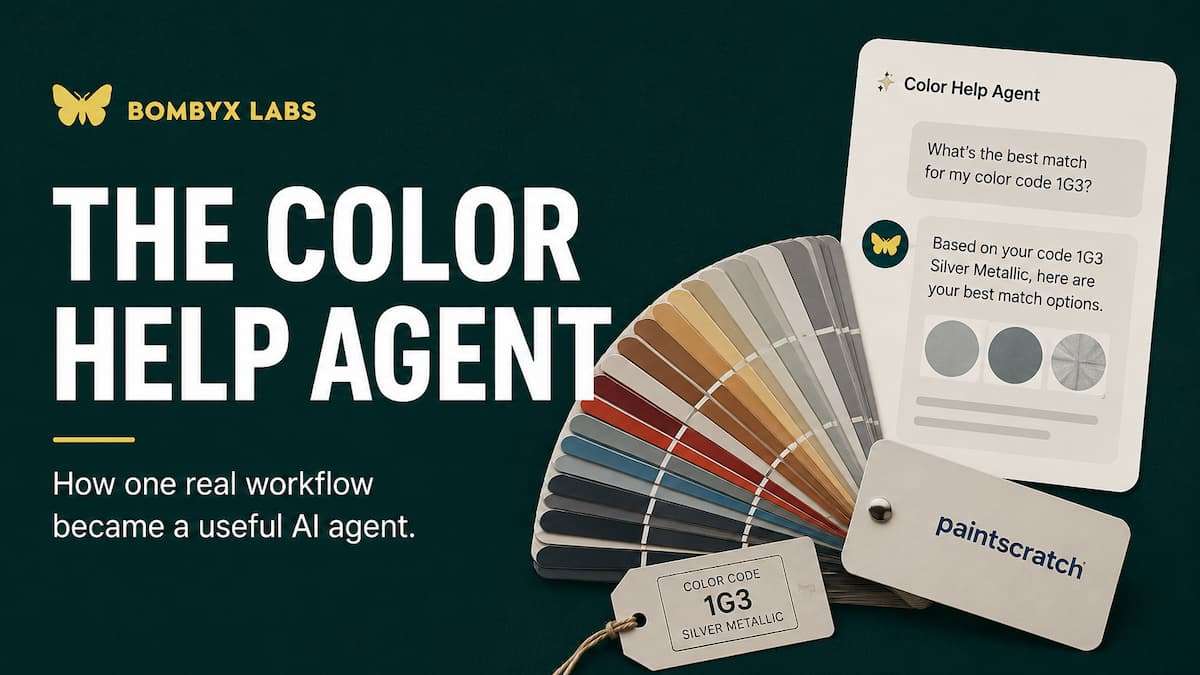
The PaintScratch Color Help AI worker started with one customer question:
“What paint color should I order?”
That sounds simple until you touch the actual work.
Sometimes the customer has a paint code. Sometimes they have a VIN label. Sometimes they send a photo of the vehicle. Sometimes they picked a color from the site and want to know if it is right.
Those are not the same case.
A clear factory paint code can be strong evidence. A VIN label usually is not enough. A vehicle photo may look helpful and still prove nothing. A selected color can be close without being safe to recommend.
If an AI system treats all of those the same, it is not helpful.
It is just fast at being risky.
The first version was narrow on purpose
The first version of the Color Help AI worker handled one narrow task.
That was the right starting point.
The first job was smaller:
Did the customer provide enough evidence to recommend a color?
If yes, help prepare the reply.
If no, ask for the smallest missing item.
Most of the time, that meant a readable photo of the paint-code tag.
Not flashy. But useful.
That is where a useful AI worker usually starts: one repeated business decision with a clear next step.
The brain got built from real cases
The real value was not that AI could write a nicer reply.
The value was that every case taught the system something.
What did the customer send?
What evidence mattered?
Which PaintScratch page needed to be checked?
What reply went out?
Where did the system need to stop?
That became the business brain.
Not a folder of documents. Not a clever prompt. Not “company knowledge” as a buzzword.
A set of checked business knowledge that changed how the next case got handled.
Over time, corrections became rules. Unusual cases became lessons. Repeated patterns became reusable guidance.
That is when the system started getting better.
The worker took on more after the rules were clear
The AI worker now does more of the job.
It checks open Color Help requests. It prepares replies. It verifies product pages. It sends safe answers when the evidence is strong enough. It checks Gmail follow-ups. It matches replies back to the right case. It archives handled messages. It routes blockers away from my inbox.
It got there one tested step at a time.
It got there because the job and its rules became clear.
The worker learned what counts as evidence, what does not, when to answer, when to ask, and when to hand off.
That restraint matters.
A business does not need AI that confidently guesses through risky cases.
It needs a trained AI worker that handles repeatable work and leaves the right decisions to people.
The AI worker takes the first pass. People stay in control.
Businesses want the work handled
One useful idea from Greg Eisenberg is simple:
Businesses do not want another AI tool.
They want the work handled.
A customer question answered correctly. A ticket routed. An inquiry followed up with. A buyer pointed to the right product. A messy inbox cleaned up.
That is the part worth paying for.
But the wrapper is not the work.
The dashboard and activity history matter because they build trust. A business owner needs to see what happened, what was sent, and where the worker stopped.
But a clear dashboard around weak rules is still not useful.
For Color Help, the real worker is built from evidence rules, catalog checks, reply steps, Gmail follow-up, handoff rules, a clear record of each case, and lessons from past cases.
That is the work behind the work.
The useful framework
For this kind of AI worker, I keep coming back to four parts:
Evidence: What does the customer provide, and is it strong enough?
Action: Should the system answer, draft, ask, check, send, or route?
Handoff: Where should the system stop?
Memory: What should this case teach the system for next time?
That is a better starting point than asking, “What job should an AI worker handle?”
Start with the job.
Define what “done” means.
Decide what the system can do safely.
Decide where people stay in control.
Then improve it from real cases.
That is how a useful AI worker gets trained.
The chatbot is just the box.
The brain is what makes it useful.
And when that knowledge is tied to a real job, the conversation changes.
You are not selling access to software.
You are selling the work getting done.