Most AI workshops teach you about AI.
That can be useful. But it often leaves business owners in a familiar place: slightly more informed, still unsure what to do next, and no closer to having something working inside the business.
That is the part we are trying to change.
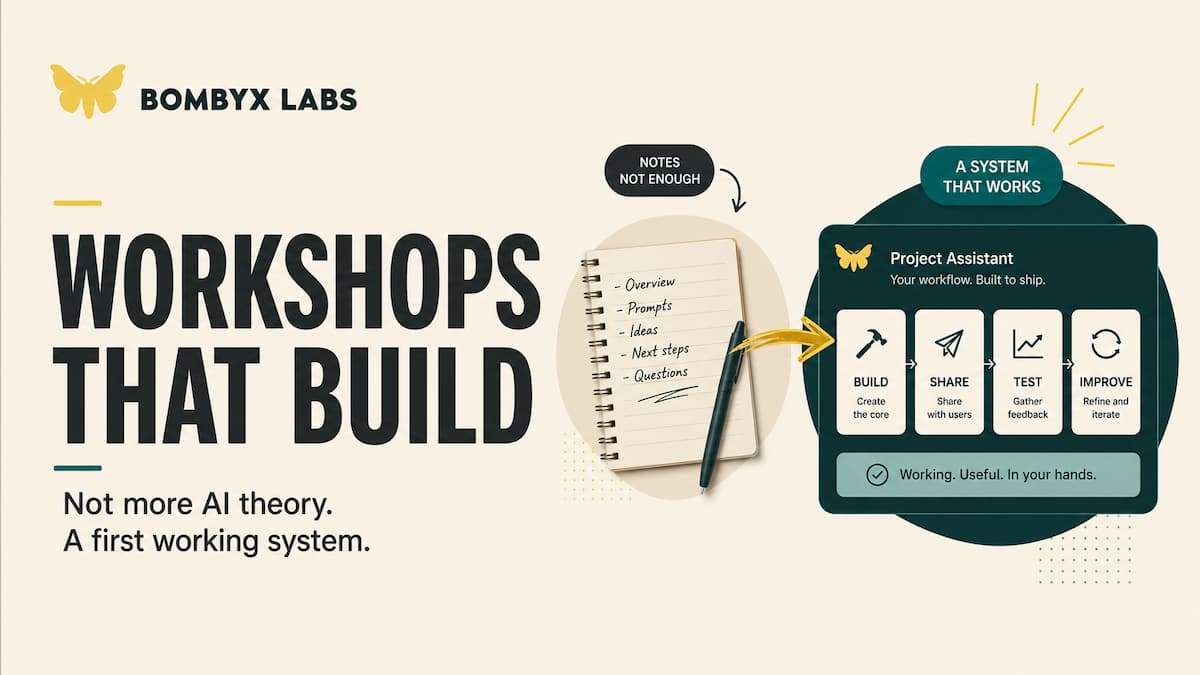
Our workshop format is built around a simple idea: the best way to understand a useful AI worker is to train a small first version, let someone else test it, and improve it from a real question.
That is the format behind Turn Visitors into Customers, our hands-on workshop for business owners and local organizations. If a session is open, that page has the current details. If the date has passed, it still shows the kind of workshop we run and the outcome we care about.
The point is not to sit through a lecture about the future of AI.
The point is to leave with a first working AI worker.
Train. Share. Test. Coach. Improve.
Most businesses do not need another AI demo
Business owners have already seen enough demos.
They have seen the chatbot that writes a poem. The tool that summarizes a meeting. The video of someone building an app in five minutes. The big promise that AI is going to change everything.
Fine. Maybe it will.
But that does not answer the practical question a business owner is asking right now: “What should I actually use this for?”
A better starting point is the work already sitting in front of the business. Customers ask the same questions. Website visitors get stuck. Customer inquiries arrive without enough detail. People want pricing, availability, service area, next steps, fit, timing, and trust before they are ready to talk.
That is real work.
That is a good job for a trained AI worker, as long as it knows the business it is helping.
The worker needs to know your business
The visible assistant is one kind of AI worker. The important thing is the checked business knowledge underneath it.
A chatbot is just the box. The brain is what makes it useful.
By business brain, I mean the working knowledge of the business: what you do, who you help, where you work, how you explain pricing, what makes someone a good fit, what questions people always ask, how your team talks, and where the assistant should stop and hand off to a person.
Most of that knowledge already exists. It is just scattered across the website, inboxes, old proposals, documents, staff memory, and the owner’s head.
The workshop does not try to organize all of that perfectly in 90 minutes. That would be the wrong goal.
The goal is to create a useful first version, then improve it from real use.
The first version should be testable, not perfect
Trying to make the first version perfect is one of the easiest ways to never launch anything.
You start thinking about every service, every edge case, every policy, every customer type, every weird exception. Then the project becomes too big before it has done anything useful.
So we start smaller.
In the workshop, each person gives the assistant enough business knowledge to answer basic visitor questions and point people toward a reasonable next step. Not the whole company. Not every possible answer. Just enough to test.
That first version should feel a little unfinished.
Good.
Unfinished means it can start learning.
Someone else has to try it
If you only test your own assistant, you will probably ask it questions that make sense to you. You know your business too well. You know the right words. You know what the website means. You know which details are obvious and which ones are hidden.
A real visitor does not have that advantage.
So in the workshop, people share their assistant with someone else in the room. The other person asks like a visitor. They ask the obvious question, the buying question, the messy question, and the question where the assistant should be careful.
That is where the useful feedback shows up.
Maybe the assistant gives a decent answer but no next step. Maybe it sounds generic. Maybe it gets too confident. Maybe it misses the service area. Maybe it should ask a follow-up question before answering. Maybe it reveals that the business has never clearly written down something customers ask all the time.
That is not failure.
That is the signal.
The assistant is showing where the business brain needs better knowledge.
The quick win is one improvement
The best workshop outcome is not a perfect assistant. It is one saved improvement that came from a real question.
That could mean adding a better pricing explanation. Clarifying the service area. Improving the next step. Adding a rule about when to hand off to a human. Teaching the assistant not to answer something risky. Making the tone sound more like the actual business. Adding the missing detail that everyone assumed was obvious.
One improvement is enough to make the loop real.
A person asked something. The assistant exposed a gap. The owner taught the brain. The next answer got better.
That is the habit we want people to learn.
Because a useful AI worker is not a one-time setup. It improves as real questions come in.
Real questions are better than guesses
Most websites show you traffic, clicks, and form fills. They usually do not show you the questions people had before they left.
That missing layer matters.
If visitors keep asking whether you serve their area, the website probably is not clear enough. If they keep asking about price, the pricing language may need work. If they keep asking which option fits, the buying path is making them work too hard. If they ask about something you never mention, that is not just a support issue.
That tells you what customers need.
A trained AI worker can help the visitor in the moment, but it can also help the business see what visitors are trying to do.
That is one of the most useful parts of this whole thing.
The assistant does not just answer questions. It catches the questions your website used to lose.
Skepticism belongs in the room
People have real concerns about AI: electricity, water, jobs, privacy, quality, ownership, hype, and who benefits.
Those concerns are fair.
We do not think the answer is to pretend AI is magic. We also do not think local businesses should ignore the technology while only the biggest companies learn how to use it.
Our answer is to start narrow and keep people in control.
One business. One trained AI worker. One clear job. Human review where it matters. Clear rules about what the worker should answer, what it should ask, and where it should stop.
The assistant should not run the business. It should not make up policies. It should not replace judgment. It should take a first pass, answer simple questions, show what people are asking, and hand off when the situation needs a person.
Less fantasy. More control.
What people should leave with
A good workshop should change what someone can do when they leave.
That is why this format is hands-on.
People leave with a first trained Website Assistant, a shareable training link, feedback from another real person, and one improvement saved back into the business knowledge.
More importantly, they leave with a clearer way to think about AI.
Do not start with the tool. Start with what the business knows. Train one useful AI worker from it. Put it in front of real questions. Improve what comes back.
That is how an AI worker starts to become useful inside a real business.
Not by chasing every tool.
Not by waiting for the perfect system.
Not by pretending the first version will be flawless.
Start with the brain. Build the smallest useful thing. Let real questions show you what to teach next.
That is the workshop.
And honestly, that is the work.