
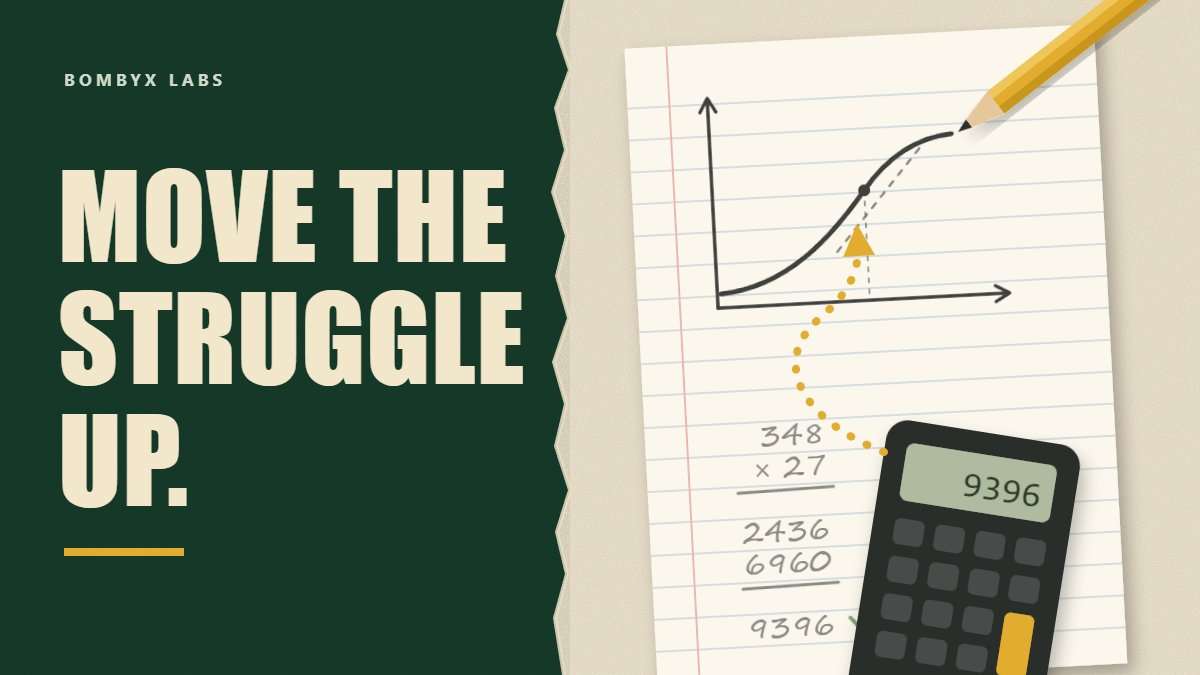
When I was helping the Tahoe Truckee Unified School District work out how AI should fit into its schools, someone brought up the calculator. Schools fought calculators when they first showed up in classrooms. Over time, most landed on a sensible middle ground. You learn to do the math by hand, enough times that you understand what is going on. Once the long calculations stop teaching you anything, you pick up the calculator and put your effort into harder problems you could not have reached before.
The phrase that came with that example was “productive struggle.” It is the kind of effort that makes you better at something. Working through long division the first few times is productive. Working through it for the five hundredth time is just slow. The calculator did not get rid of the struggle in math class. It moved the struggle up to the next thing worth learning.
That idea came back to me again and again while I listened to Wharton professor Ethan Mollick on Marina Mogilko’s Silicon Valley Girl podcast. The interview covers what AI can and cannot do right now, and what we should still do ourselves. I went back and listened to parts of it again. Almost every part of it was, to me, a conversation about where the struggle should go.
Let AI take the crap work
Mollick drew a line between two futures. In an automation world, AI takes over our jobs, and that goes badly for most people. In what he called an augmentation world, “you do the interesting stuff and the AI does the crap stuff.” He said he can’t wait to stop doing a pile of useless tasks so he can spend more time on the parts of his work he cares about.
That is the calculator again, at work scale. Filling out forms, reformatting a spreadsheet, working through a compliance checklist: very little of that makes me better at anything I care about. Handing it off frees up time and attention for the problems that do.
He also warned against a mistake I make more than I’d like to admit. People look at what AI gets wrong today and assume it will always get it wrong. This technology improves fast enough that a limit I ran into a few months ago may already be gone. So the line between “hand this off” and “do this yourself” keeps moving, and I have to keep testing where it sits instead of deciding once.
Shiny things make it easy to skip the hard part
There is a catch. When AI makes it cheap to start things, every new idea looks easy and every hard problem looks like a reason to move on. Mogilko said it plainly in the interview: there are so many shiny things around you. I have been guilty of chasing them for ages, and AI has made it worse.
The clearest example right now is a repair advisor I’m building for PaintScratch. It is meant to help customers figure out what to do about damage to their car’s paint. AI got me to a working start quickly. Then I hit the edge cases, the ones where the right answer is hard to pin down, and I set the advisor aside to work on something that felt more exciting. Eventually I came back, because I knew it mattered. Then I hit another hard case and wandered off again.
Looking back, those edge cases are the productive struggle. They are where I have to work out what good advice looks like for a real customer with a real car. Dropping the project every time it got hard meant skipping the part that would make it good.
Aim higher, then stay with it
Mollick said something that stung a little: people aren’t being ambitious enough. We have the equivalent of hundreds or thousands of very smart helpers at our fingertips, and a lot of us are using them to shave a few minutes off tasks we were already doing. He pushes his students to think past selling picks and shovels and use the new tools to dig for something bigger themselves.
Nate B. Jones made a similar case in a recent video and essay. His advice is to pick a project you shelved because it once took more time, money, or help than you had, and give it a bigger attempt now. Those costs have changed, so the old decision deserves another look.
Nate also named the trap I described above: starting new projects so often that the ones you already have never get finished. For me, being bold means taking the one hard thing I care about and pushing it further than I could have alone. Big ambition and productive struggle go together. The bigger the goal, the more hard parts you will run into, and the more it matters that you stay with them.
Managing AI is its own kind of struggle
One of Mollick’s points surprised me at first and then seemed obvious. He said the skills that make someone a good manager are now the skills that make someone good with AI, and joked that it is “the revenge of the MBAs.” He described a study that found managers wrote better code than programmers on the first pass, because they knew how to describe the problem and what a good result looked like before they handed it off. In his words, techniques that work on people work on AI. Spell out the goal, say what good looks like, watch for problems early, and set up regular check-ins.
He was firm that the biggest mistake people make is trusting AI agents too much. He wants forced points where the agent stops and reports back, so a person can steer before the work goes too far.
That one landed. In my own work, I’ve drifted too far out of the loop. I want to say “make it so” and walk away, and sometimes I do. Then I come back hours later to find an agent has done a lot of work that isn’t what I thought I asked for. The agent’s hours were cheap, but my time sorting out what went wrong was not. So I’m putting the check-ins back: a clear description of the result I want, a look at the first example before the agent repeats it everywhere, and a few planned stops along the way.
This is where my own struggle has moved. The calculator handles the arithmetic, but somebody still has to set up the problem. Describing what good means, precisely enough that someone else can deliver it, is hard work. I’ll keep watching as these agents get more capable, because they are improving quickly. At some point “make it so” may really be enough, as long as I’ve done the work of describing what “so” is.
Where judgment and taste come from
The part of the interview I keep thinking about is the one Mollick said he did not have a good answer for. For a very long time, people learned judgment and taste on the job. Apprentices, interns, and entry-level workers did the unglamorous work, and in return they learned how experienced people made decisions. Mollick said we have broken the system that forms professional taste and judgment, and we haven’t figured out a full replacement yet. If companies stop hiring beginners because AI can do the beginner work, it is fair to ask where the next experienced people will come from.
I have three kids, so that question isn’t abstract for me. I wonder what they will bring to the table in the world they’re growing into, and how they will build judgment if the entry-level work that used to teach it is gone.
Mollick’s advice for now applies to them and to me. Be deliberate about what he called cognitive surrender, the thinking you let AI do for you. Choose some hard things on purpose. He said that if it isn’t uncomfortable, you probably aren’t doing much learning. Skills work like muscles. If you hand off something you want to be good at, that muscle weakens.
That doesn’t mean doing everything the hard way. If a task is crap work to you and sits outside anything you need to understand, hand it off and don’t look back. Just be honest that you won’t get better at it, and over time you’ll understand it less. The question I’m learning to ask is whether I want to be good at this. If the answer is yes, I keep some of the struggle.
Look for the bottlenecks
Mollick and his coauthors have a name for how uneven AI’s abilities are: the jagged frontier, from their study of consultants at Boston Consulting Group. AI is surprisingly good at some tasks and surprisingly bad at others, and it is hard to predict which is which. In the interview he added that even as AI gets more capable, there are always bottlenecks people need to fill. Some are legal or regulatory. Some exist simply because a customer wants to talk to a person.
Those bottlenecks shift as the frontier moves, so they are worth checking often. They are also a good place to look for opportunity and for productive struggle. If something still needs a person, it is probably worth getting good at.
Choosing where to struggle
The calculator debate eventually stopped being about whether students should use one. It became about when, and what the struggle was for. That is the question I’m asking about AI now.
I’m happy to let AI take the crap work. I want to spend the time it saves on bigger goals, not just more of them. I want to stay close enough to the work to steer it. And I want to keep choosing some hard things on purpose, for my own sake and as an example for my kids. Right now, that means going back to the repair advisor’s hard cases and staying with them this time.